

What Makes the OM3500 Total Hydrocarbon Analyzer Ready for Field Detection?
Release time: 2026-09-16
Table of Contents
Field detection often takes place in less-than-ideal conditions. Operators may need to move between different areas, check multiple points in a short time, or work outdoors where access to power and laboratory equipment is limited. In these situations, an analyzer needs to be accurate, but it also needs to be easy to carry and practical to operate.
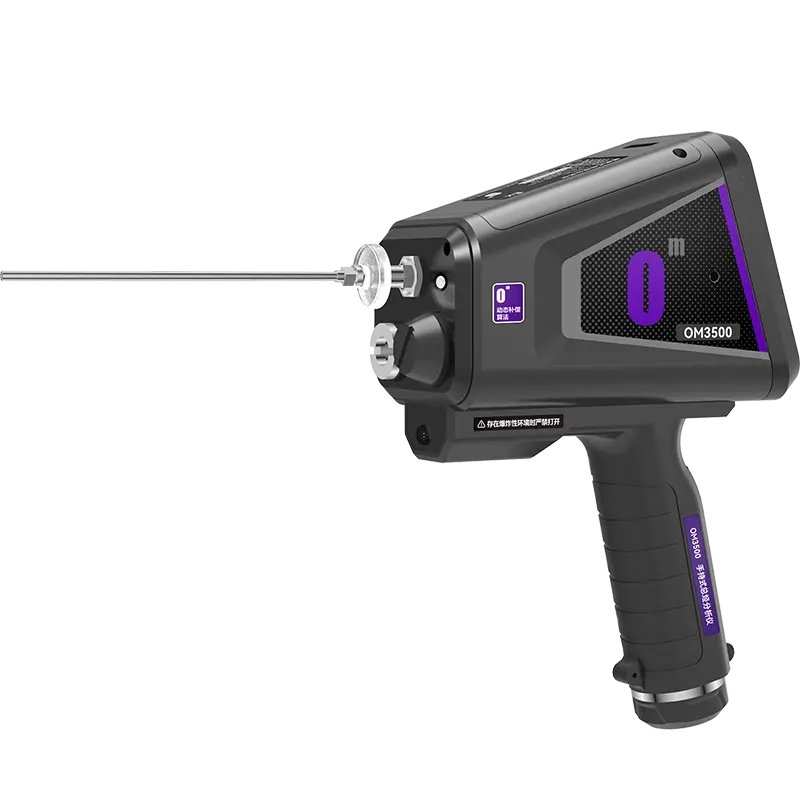
Anh ui Aoma Intelligent Technology Co., Ltd. developed the OM3500 with these requirements in mind. As a compact total hydrocarbon analyzer, it uses FID technology for rapid hydrocarbon detection and combines a lightweight design with battery operation, built-in hydrogen storage, and several functions intended for mobile field work.
What Does the OM3500 Offer for Field Detection?
The OM3500 is designed for users who need to measure hydrocarbon concentrations directly at the inspection site rather than send every sample back to a laboratory.
Its main configuration includes an FID detector, while a PID detector is also available as an option. The FID range reaches 0–50,000 ppm methane, giving the instrument a broad measurement range for different field conditions.
| Parameter | OM3500 Specification |
| 検出器 | FID, PID optional |
| FID Range | 0–50,000 ppm methane |
| PID Range | 0.5–2,000 ppm isobutene |
| 応答時間 | <3.5 s |
| Detection Limit | FID: 0.5 ppm methane; PID: 0.5 ppm isobutene |
| 再現性 | ≤2% |
| 正確さ | ≤2% |
| Preheating Time | ≤20 min |
| サンプリングフロー | 0.1–3.0 L/min, rated 1 L/min |
| Operating Temperature | -10°C to +50°C |
| Relative Humidity | 0–95% |
| Battery | 6400 mAh |
| Battery Runtime | ≥8 h at room temperature |
| Hydrogen Runtime | ≥12 h at room temperature |
| 重さ | ≤1.6 kg |
| コミュニケーション | Bluetooth / Wi-Fi / USB |
| Protection | Ex db ib IIC T4 Gb |
These specifications make the instrument suitable for situations where measurements need to be taken quickly and repeatedly across different locations.
Designed to Move with the Operator
A field analyzer should not become a burden after several hours of use. With a weight of no more than 1.6 kg, the OM3500 is compact enough to be carried between inspection points.
The instrument uses a 6400 mAh battery, with a stated operating time of at least eight hours at room temperature. This can cover a typical working day without requiring frequent charging.
Another useful feature is its built-in hydrogen supply. Instead of relying on an external high-pressure hydrogen cylinder, the OM3500 uses a replaceable 20 L solid-state low-pressure hydrogen storage alloy cylinder. The hydrogen system is supported by water electrolysis technology, while the stated hydrogen runtime is at least 12 hours under room-temperature conditions.
For mobile work, reducing the amount of supporting equipment can make the overall inspection process much easier.
Quick Measurements at Multiple Detection Points
Field inspections rarely involve a single measurement. Operators may need to check several points around equipment, production areas, pipelines, or facility boundaries.
The OM3500 has a response time of less than 3.5 seconds under the specified test conditions. Its sampling flow can also be adjusted from 0.1 to 3.0 L/min, with a rated flow of 1 L/min.
This gives operators more flexibility when moving from one detection point to another. Instead of waiting a long time for every reading, they can carry out a series of measurements and identify areas that require closer attention.
A Wide Range for Different Hydrocarbon Levels
Concentration levels can vary considerably during field inspections. Some locations may have only low-level background concentrations, while others may show much higher readings.
The FID version of the OM3500 covers 0–50,000 ppm methane, with a detection limit of 0.5 ppm methane. For applications requiring PID detection, the optional PID configuration covers 0.5–2,000 ppm isobutene.
The specified repeatability and accuracy are both within 2% for the corresponding detector configuration. A broad range combined with low detection limits allows the instrument to handle both routine screening and areas where higher concentrations may be encountered.
FID at the Core of the Detection System
The detection system is one of the most important parts of any field analyzer. The OM3500 uses FID technology and incorporates several design features to keep the detection process stable.
Its micro-EPC system controls the hydrogen flow for stable combustion. The independent FID chamber is designed to reduce interference, while a dual ignition system can automatically reignite the detector if the flame goes out.
The instrument also performs automatic gas-line purging when starting up and shutting down. These functions are particularly useful during repeated field measurements, where stable operation matters as much as the basic detection principle.
Battery Life for a Full Day of Field Work
Long inspection routes can make battery life a practical concern. Constantly stopping to recharge an analyzer is not ideal when several areas need to be checked.
The OM3500 is specified to operate for at least eight hours on a full battery under room-temperature conditions. Combined with its portable design, this gives operators more freedom to work away from fixed facilities.
The hydrogen storage system also provides a stated runtime of at least 12 hours at room temperature. In normal field use, both power and hydrogen capacity are important factors to consider when planning a day’s inspection work.
Useful Functions for Everyday Operation
The OM3500 is not limited to displaying concentration readings. Several built-in functions are intended to make routine operation easier.
The instrument can provide reminders for low battery levels, excessive leakage, abnormal airflow, consumable replacement, and maintenance. These prompts can help operators notice potential issues before they affect the inspection process.
Bluetooth, Wi-Fi, and USB communication are also available. An optional camera module and auxiliary lighting can be added for work that requires visual assistance, particularly during inspections in poorly lit areas or at night.
The 3.5-inch touchscreen keeps the main operating interface within easy reach, which is useful when measurements need to be taken while moving between different points.
Considerations for Industrial Environments
Field detection equipment may be exposed to changing temperatures, humidity, dust, and other conditions that are not common in laboratory environments.
The OM3500 is specified for operation from -10°C to +50°C and relative humidity of 0–95%. It also carries an Ex db ib IIC T4 Gb protection classification, making its safety design an important consideration for applicable industrial environments.
Of course, the actual suitability of any analyzer still depends on the working site, gas composition, and applicable safety requirements. Users should select the configuration according to the conditions in which the instrument will be operated.
Where the OM3500 Fits into Field Work
The OM3500 can be used for a range of on-site hydrocarbon inspection tasks. Typical applications include rapid screening of organized and unorganized VOC emissions, VOC checks around factory boundaries, enterprise self-inspection, third-party testing, and short-term leak detection.
Its relatively light weight and self-contained power and hydrogen supply are particularly useful when inspection points are spread across a large site.
For operators who need a handheld total hydrocarbon analyzer that can be carried from one location to another, these practical details can be just as important as the detector itself.
Putting the Features Together
The value of the OM3500 comes from how its individual features work together.
The FID system provides a wide measurement range, while the fast response helps shorten the time spent at each detection point. Battery operation and built-in hydrogen storage reduce dependence on external equipment. Functions such as automatic ignition, gas-line purging, and operating reminders are intended to make repeated field measurements more manageable.
This combination gives the instrument a clear focus: taking laboratory-style detection capabilities into situations where portability and quick operation are important.
A Practical Choice for On-Site Measurement
A field analyzer does not need to be overloaded with features. What matters is whether its core functions work reliably when operators are moving between different locations and dealing with real working conditions.
The OM3500 brings together FID detection, a wide measurement range, portable construction, long operating time, and practical operating functions in one instrument. For users looking for an OM3500 total hydrocarbon analyzer for routine industrial inspection and on-site hydrocarbon measurement, it offers a balanced approach to portability and detection performance.
With its focus on FID gas detection technology and field-oriented instrument design, Anhui Aoma Intelligent Technology Co., Ltd. continues to develop equipment aimed at making on-site gas measurement more practical and efficient.
Frequently Asked Questions
1. What is the OM3500 used for?
The OM3500 is designed for on-site total hydrocarbon measurement and VOC leak detection. It can be used for industrial inspections, factory boundary monitoring, enterprise self-inspection, third-party testing, and other field applications.
2. What detection technology does the OM3500 use?
The standard OM3500 uses FID technology for total hydrocarbon detection. A PID configuration is also available for applications that require it.
3. How long can the OM3500 operate on one battery charge?
The OM3500 uses a 6400 mAh battery and can operate for at least eight hours at room temperature under the specified conditions. This makes it suitable for extended field inspection work.
4. What is the measuring range of the OM3500?
The FID configuration has a measuring range of 0–50,000 ppm methane, with a detection limit of 0.5 ppm methane. The optional PID configuration covers 0.5–2,000 ppm isobutene.
5. Is the OM3500 suitable for mobile field inspection?
Yes. The instrument weighs no more than 1.6 kg and has a compact handheld design. Its built-in battery, hydrogen storage system, touchscreen, and data communication functions make it suitable for moving between multiple inspection points.
6. Can measurement data be transferred from the OM3500?
Yes. The instrument supports Bluetooth, Wi-Fi, and USB communication. These options allow users to manage or export measurement data according to their field requirements.